
Homeowners need to understand that residential asphalt consists of graded aggregates bound by heated bitumen and requires controlled mixing, compaction, and temperature monitoring for performance. Mix selection—dense-graded, SMA, open-graded, warm or cold—depends on load, drainage and noise goals. Costs hinge on area, thickness, base work, grading and mobilization. Proper subgrade, drainage design and permit compliance prevent distress. Contract specifications, warranties and inspection points guarantee quality. Continue for detailed guidance on choices, costs and maintenance options.
Asphalt Paving Essentials: Basics, Mixes & PrepKey Takeaways
- Understand asphalt basics: hot-mix aggregates bound by bitumen, requiring controlled heating, mixing, and temperature monitoring for quality.
- Choose the right mix (dense-graded, SMA, open-graded, warm/cold) based on load, drainage, noise, and durability needs.
- Proper site prep—grading, subbase compaction, and drainage design—is essential to prevent settlement, ponding, and premature failure.
- Get a detailed quote including area, thickness, base work, permits, and allowances for unforeseen conditions to control final costs.
- Vet contractors for license, insurance, references, written scope, unit pricing, timeline, and warranty before signing.
How Asphalt Is Made and Why It’s Popular
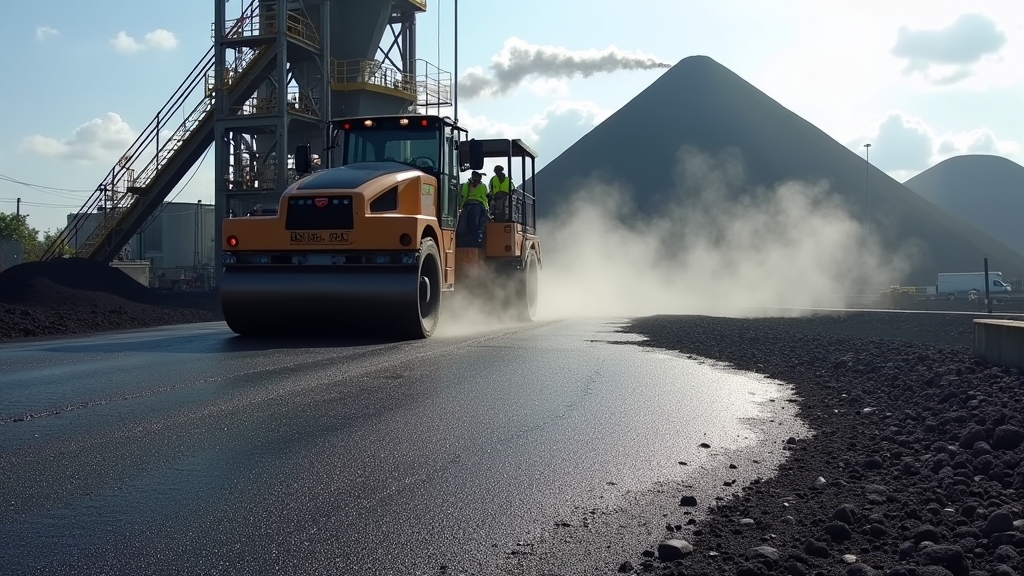
Although composed primarily of mineral aggregates bound by bitumen, asphalt is produced through controlled heating and mixing processes that yield a consistent, compactable pavement material.
The manufacturing sequence entails aggregate grading, moisture control, binder selection, and thermal homogenization to achieve target volumetrics and stability.
Quality control measures—sieve analysis, binder viscosity, temperature monitoring—ensure compliance with design specifications.
Process optimization reduces fuel use and emissions; life-cycle assessment quantifies environmental impact and informs material choices and reclamation rates.
Placement requires calibrated compaction energy and surface profiling to obtain density and skid resistance.
Durability derives from aggregate angularity, binder modification, and drainage design.
For practitioners, understanding asphalt production parameters, testing protocols, and maintenance strategies is essential to predict performance and extend service life.
Specification adherence minimizes pavement failures.
Types of Asphalt Mixes and When to Use Them

Different asphalt mix types are specified according to traffic loading, climate, and construction method. The principal categories—dense-graded, stone matrix asphalt (SMA), open-graded, and hot-, warm-, and cold-mix variants—are selected for structural capacity, permeability, and constructability.
Different asphalt mix types—dense-graded, SMA, open-graded, and hot/warm/cold—are chosen for capacity, permeability, and constructability.
Dense-graded mixes suit general residential driveways and provide rut resistance; SMA offers enhanced durability for heavier loading zones. Open-graded mixes are used where drainage or noise reduction is required. Warm- and cold-mix formulations enable lower-temperature placement for environmental constraints or limited equipment.
Selection criteria should include aggregate angularity, binder grade, volumetrics, compaction method, and expected maintenance regimen. Professionals evaluate site-specific variables to match asphalt types to precise mix applications, optimizing lifespan and performance while minimizing risk of premature distress.
Specification compliance and testing confirm long-term pavement performance periodically verified.
Estimating Costs: What Affects Your Quote

How the final quote is determined hinges on a combination of controllable and site-specific factors. A disciplined estimator isolates primary cost factors: surface area, thickness and mix selection, base preparation, drainage modifications, removals, and grading complexity.
Labor rates, accessibility, equipment mobilization, and regional material prices further adjust totals. A clear quote breakdown separates unit prices for excavation, aggregate base, binder and surface lifts, compaction, edges, and joint sealing, plus allowances for unforeseen conditions and taxes.
Accurate measurement, documented scope, and specified tolerances reduce contingency. Homeowners seeking mastery should require line-item estimates, material specifications, and projected schedule; comparative analysis of multiple bids reveals efficiency versus lowball risk, enabling informed selection based on long-term performance priorities and lifecycle cost modeling informs maintenance planning and warranty evaluation.
Permits, Codes, and When You Need Approval
Permitting and code compliance are prerequisites for residential asphalt projects and vary by jurisdiction, typically requiring a site plan, permit application, and fee payment.
Relevant building codes address grading, drainage, setback, load-bearing base requirements, and allowable materials, and contractors must guarantee designs meet those specifications.
Inspections and approvals at key stages—preparation, paving, and final—are often mandated before occupancy or connection to public right-of-way.
Local Permit Requirements
When is municipal approval required for residential asphalt paving, and which rules apply depends on jurisdictional codes and the scope of work.
The responsible party must verify local zoning designations, impervious surface limits, and right-of-way restrictions before submitting an application. Required documentation typically includes scaled site plans, drainage calculations, contractor license, and proof of insurance.
Permit fees vary by municipality; confirm fee schedules and payment methods early to avoid delays. Review timelines, inspection triggers, and temporary traffic control requirements to integrate compliance into the project schedule.
Failure to obtain permits can result in stop-work orders, fines, or mandatory remediation. For complex grading or stormwater impacts, coordination with municipal engineering is essential to secure timely approval and inspection sign-off.
Document approvals and retain records indefinitely.
Building Code Compliance
Building code compliance governs the technical standards, approvals, and inspections required for residential asphalt paving and sets the measurable criteria that municipal reviewers will enforce.
Contractors and homeowners must reference local building regulations to determine permit triggers, edge setbacks, drainage grades, load-bearing specifications, and material compositions. Compliance standards dictate documentation: engineered plans, compaction reports, material test certificates, and inspection schedules.
Approval is required when work alters drainage, increases impervious surface area beyond thresholds, or modifies curb cut or right-of-way access. Project planning should include permit timelines, fee calculations, and contingency for corrective actions.
Final acceptance hinges on documented inspections and as-built evidence. Mastery requires verifying jurisdictional code sections, condition-specific exceptions, and maintaining traceable records to demonstrate conformity and consistently engaging qualified code-savvy contractors early.
Site Preparation and Drainage Considerations
Proper grading and slope are established to guarantee positive runoff away from structures and to prevent ponding.
Adequate subbase compaction is required to achieve uniform-bearing capacity and to minimize differential settlement under traffic loads.
Drainage system planning—including inlet placement, conveyance paths, and outlet protection—must be coordinated with grade and compaction to preserve pavement performance.
Grading and Slope
Although often overlooked, grading and slope are critical to pavement performance because they control surface drainage, prevent water infiltration into the base, and reduce pavement distress.
Practitioners evaluate existing topography, establish target cross slope and longitudinal grade, and apply proven grading techniques to direct runoff toward inlets or natural drains while avoiding ponding.
Slope assessment quantifies minimums—typically 1% cross slope—and maximums compatible with vehicle dynamics and ADA where applicable.
Shift zones and crown profiles are specified to limit texture-related hydroplaning and edge erosion.
Tolerances are tight; plans include contours, spot elevations, and profiles verified by laser or total station.
Successful execution minimizes maintenance, preserves base integrity, and extends pavement life through controlled surface water management.
Design documentation must define design slopes and inspection criteria.
Subbase Compaction
Establishes a uniformly compacted subbase that provides structural support and unrestricted drainage by specifying target densities, lift thicknesses, moisture conditions, and compaction equipment for each material type. Specification mandates: design subbase thickness and select crushed stone, recycled aggregate, or stabilized materials; control moisture to within optimum ±2%; compact lifts to 95%+ relative density using vibratory rollers, plate compactors, or rammers as appropriate. Table summarizes typical parameters.
| Material | Lift Thickness | Target Density |
| Crushed stone | 4-8 in | ≥95% |
| Recycled aggregate | 3-6 in | ≥95% |
| Stabilized (cement) | 2-4 in | ≥98% |
| Select fill | 6-12 in | ≥95% |
Field verification via nuclear gauge and proof-rolling enforces conformity to design. Contract documents should specify testing frequency, acceptance criteria, corrective actions, and contractor qualifications to guarantee long-term pavement performance and documentation control procedures.
Drainage System Planning
When planning drainage for residential asphalt pavements, the design must integrate surface grading, subsurface collection, conveyance, and discharge so that water is rapidly diverted away from the pavement structure and adjacent foundations.
The practitioner evaluates site topography, soil permeability, frost susceptibility, and expected runoff to select drainage options that minimize infiltration and hydrostatic pressure.
Surface solutions include crowns, cross slopes, curbs, and swales; subsurface solutions include longitudinal drains, perforated pipes, and geotextile-wrapped French drains.
Conveyance systems must maintain capacity for peak flow with positive outlet gradients; discharge points require erosion control and legal compliance.
Effective water management coordinates structural detail, routine maintenance access, and inspection intervals.
Documentation of calculations, plans, and materials guarantees performance and simplifies future remediation and long-term asset protection, plus liability.
Common Pavement Problems and Repair Options
Because pavement distresses vary in cause and severity, accurate diagnosis is critical to selecting an appropriate repair method. The common failures—transverse, longitudinal and alligator cracking; edge break; rutting; and potholing—require specific remediation.
Cracking solutions include crack routing and sealing for non-structural, full-depth patching for structural failures, and overlay where substrate integrity permits; selection depends on load, subgrade condition and moisture.
Match cracking treatments—routing and sealing for surface cracks, full‑depth patching for structural failures, or overlay when substrate allows.
Pothole repair demands removal to sound pavement, cleaning, proper tack, and layered hot or cold-mix compaction to restore interlock and prevent progressive failure.
Surface treatments—sealcoats, chip seals—and milling with overlay address oxidation and minor profile deficiencies.
Prioritization is driven by failure mechanism, traffic demands and lifecycle cost analysis to optimize performance and budget.
Monitoring and scheduled interventions extend service life and reduce whole-life costs.
Choosing a Contractor: Questions to Ask and Red Flags
How should a property owner evaluate asphalt contractors to minimize risk and guarantee performance?
The assessor should verify contractor qualifications: licensing, bonding, insurance limits, documented portfolio, references with measurable outcomes, and material certifications.
Request written scope, unit pricing, and warranty terms tied to specific defects and cure remedies.
Probe subcontractor relationships, quality-control procedures, compaction standards, and testing protocols.
Clarify project timelines in the proposal, milestones for mobilization, inspection points, and penalties for delays.
Red flags include vague contracts, unusually low bids, cash-only deals, lack of verifiable references, absence of performance guarantees, and pressure to sign.
Decisions should be evidence-based: compare proposals against specification checklists, prioritize contractors demonstrating technical competence, recordkeeping discipline, and transparent risk allocation.
Maintain documented communication trails and retain all contractual documents.
Installation Timeline and What to Expect on Job Day
Although schedules vary with project scope, weather, and base condition, a residential asphalt installation proceeds through a defined sequence that the owner should expect and verify: mobilization and site protection, removal of existing pavement and debris, subgrade evaluation and any necessary excavation or stabilization, placement and compaction of base material, primer/tack application, sequential hot‑mix asphalt lifts with specified laydown temperatures and compaction passes, edge and joint finishing, surface profiling and drainage verification, and final cleanup and inspection.
On job day crews confirm material temperatures, equipment calibration, and traffic control; the superintendent documents crew assignments, lift thicknesses, compaction targets, and test locations.
Homeowner responsibilities include access restrictions and utility clearances. The project timeline should define contingencies and quality‑assurance inspections to guarantee tolerances and acceptance criteria.
Maintenance, Sealing, and Extending Pavement Life
When performed on a scheduled, condition-driven basis, routine maintenance and timely surface treatments greatly extend the service life of residential asphalt by arresting moisture intrusion, limiting oxidation, and restoring surface friction.
A disciplined maintenance schedule prioritizes crack sealing, pothole repair, drainage correction, and periodic sealcoating to preserve structural integrity and prevent progressive failure.
Selection of sealant types should be systematic: hot-applied rubberized asphalt for high-movement joints, polymer-modified emulsions for large areas, and cold-pour fillers for isolated cracks.
Inspection intervals depend on traffic load and climate; typical cadence ranges from annual visual inspections to thorough evaluations every three to five years.
Recordkeeping, performance metrics, and lifecycle cost analysis guide interventions, ensuring proactive asset management and maximum remaining service life.
Contractor qualifications influence long-term outcomes considerably.
Conclusion
Residential asphalt paving is more than just laying down blacktop — it’s about combining the right mix, base preparation, drainage design, and maintenance strategy to achieve a driveway that performs and lasts. By understanding the fundamentals of asphalt mixes, cost drivers, permit requirements, and proper site preparation, homeowners can avoid costly mistakes and ensure their investment delivers both functionality and curb appeal.
For lasting results, it’s crucial to work with experienced professionals who bring both technical expertise and local knowledge. AtAll Around Asphalt, we specialize in every aspect of residential paving — fromnew driveway installations toasphalt resurfacing,sealcoating, andasphalt repair. Our team ensures every project is built on solid foundations with durable materials, proper drainage, and precise compaction.Ready to protect your property value with a driveway that lasts? Call us today at862-283-9101 or request a free quote through ourcontact page. Trust All Around Asphalt to deliver reliable, code-compliant paving solutions that maximize performance, safety, and long-term value.